
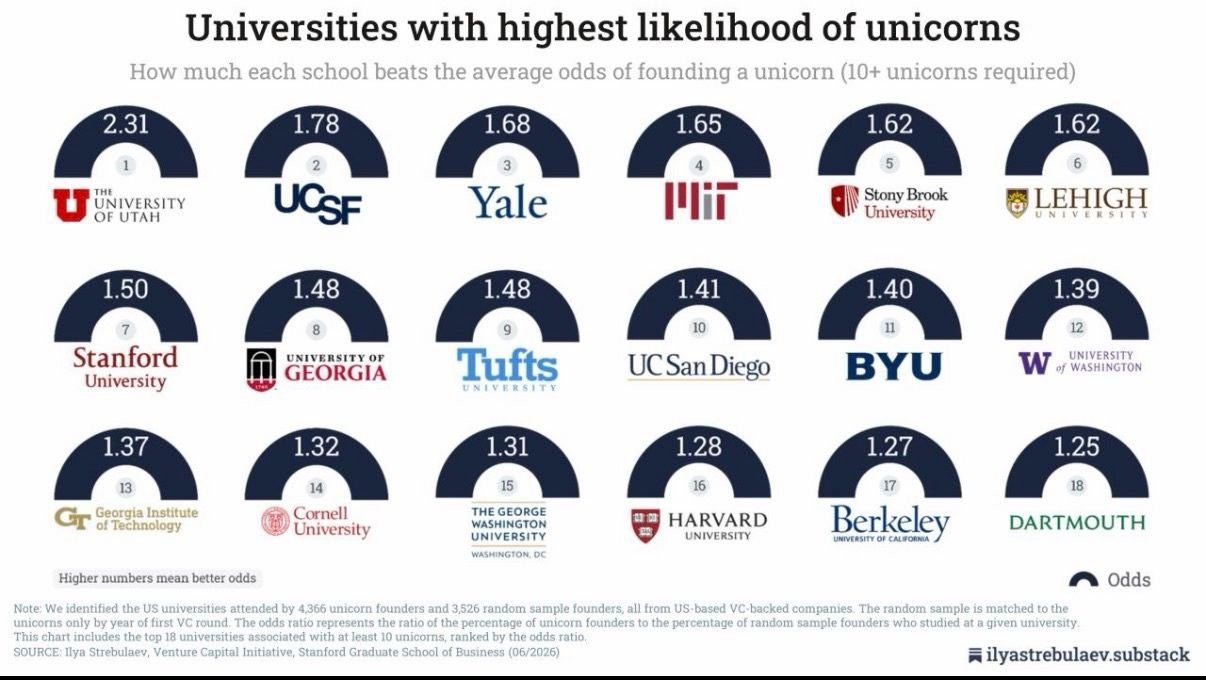
The (#1) University of Utah and (#11) Brigham Young University (BYU) were recently listed in the “Universities with highest likelihood of unicorns” rankings among all major universities in the U.S. by Professor Ilya A. Strebulaev, Stanford Graduate School of Business. These are elite universities that produce entrepreneurs who successfully build and scale a privately held startup “unicorn” to a valuation of $1 billion or more.
The goal of producing unicorns has shifted how many top-tier universities view higher education. Rather than just being centers for lectures and research, a distinct category of “Unicorn-versities” now operate as full-scale startup engines.
The resources required to build university accelerators, fund campus venture capital arms, and construct massive innovation hubs are substantial. Universities make this investment for several reasons. Many universities operate on an “IP-first” model. When groundbreaking research from university labs, especially in biotech, AI, and advanced engineering, is commercialized, the university often retains a percentage of equity or licensing rights.
Successful unicorn founders become ultra-high-net-worth individuals. When a university’s ecosystem serves as the launchpad for that success, those founders frequently give back. Traditional academic prestige is increasingly sharing the spotlight with entrepreneurial output. When a university consistently produces billion-dollar founders, its global brand skyrockets.
Utah and BYU act as primary economic anchors for the state of Utah. By fostering high-growth startups, they create a cycle of local economic resilience. For an entrepreneurial or ambitious student, attending a university that prioritizes scaling high-value startups offers an entirely different collegiate experience than a traditional institution.
Instead of just learning business theory from a textbook, students have access to equity-free seed grants, university-backed venture funds, prototype labs, and dedicated incubator spaces. Securing a spot in a prestigious university accelerator signals quality to the broader venture capital world. Students get direct access to angel investors, venture capitalists, and tier-one mentors who routinely scout the campus for the next big idea.
Building a company is risky. These local universities create a place where students can stress-test a business model, build a product, and even fail, all while continuing their education and utilizing free legal, operational, and technical resources.
The culture at these schools is collaborative. A student studying economics can easily link up with a peer majoring in computer science or data science to build a founding team. Prospective students choose Utah and BYU because they don’t just want a degree that proves what they know, they want an ecosystem that accelerates what they can build.